
Smash and Grab (AKA Payment Notice Dispute) Adjudications: Where are we now?
“Smash and grabs” are the most common type of adjudication1 and there is some evidence they are increasing in frequency in the current economic environment. The rules surrounding payment cycles are relatively straightforward and were designed to provide certainty and ensure that cash flow was maintained in the industry.2 Perhaps then the use of the term “smash and grab” (and its arguably negative connotations) should be banned and the less negative term “Payment Notice Dispute” used instead. After all, those initiating a smash and grab adjudication (assuming they are successful) are simply enforcing their statutory rights.
It is alarmingly common to find contract terms that do not reflect the payment provisions of the Housing Grants, Construction and Regeneration Act 1996 (as amended) (the “Housing Grants Act”), and/or for those responsible for serving the necessary notices to misunderstand the requirements. This is despite the potentially severe consequences of failing to serve the correct notices and/or failing to serve them on time.
This Insight provides a comprehensive guide to “smash and grab” adjudications (or “Payment Notice Dispute” adjudications) and an update on the position as it stands at the beginning of 2026. In doing so, we will look at the basics that give rise to the right to require payment of the notified sum along with recent guidance from the courts.
So, what is a “smash and grab” adjudication?
The phrase “smash and grab” was first mentioned in the case of CG Group Limited v Breyer Group PLC3 and arises because of a failure by the payer to submit a timely or valid payment notice or pay less notice. As summarised by Carr J (as she then was) in Jawaby Property Investment Ltd v The Interiors Group Ltd and others:4
“The interim payment provisions in the Contract reflect the requirements of s. 110A and s. 111 of the [Housing Grants] Act. Their effect is to require an employer at periodic intervals to pay ‘the notified sum’ by a final date for payment, irrespective of whether or not that sum in fact represents a correct valuation of the work to date. If an employer fails to give relevant notice, irrespective of whether this is by mistake, administrative oversight or any other reason, then a sum for which the contractor has applied becomes immediately contractually payable, even if it is wrong in valuation terms” [emphasis added].
Therefore, provided that its application is valid and in accordance with any requirements of the relevant contract, the payee is entitled to payment in full of the sum applied for in the absence of a payment notice or pay less notice.
Although often hotly disputed, ultimately where there is a valid smash and grab adjudication, the parties are simply enforcing their rights to cash flow, and this attitude has been mirrored by the courts. As explained by Fraser J in Imperial Chemical Industries Limited v Merit Merrell Technology Limited:5
“As a term for this type of dispute or adjudication, in my judgment the phrase ‘smash and grab’ is best avoided. The phrase clearly has pejorative overtones. Parliament, both in the original legislation, the Housing Grants, Construction and Regeneration Act 1996, and now as amended in the Local Democracy, Economic Development and Construction Act 2009, has decided that certain timing requirements must be met so far as interim payment applications, and decisions to pay less than the amount applied for, are concerned. If employers or third party certifiers fail to comply with those legal requirements, then the party seeking payment (usually the contractor) becomes entitled to the sum (as an interim payment) for which application has been made. To describe an attempt, or the adjudication itself, by a party to enforce these legal rights as a ‘smash and grab’ entirely misses the point” [emphasis added].
What are the payment provisions?
As foreshadowed by the Latham Report, the Housing Grants Act includes multiple provisions to encourage timely payments throughout the construction industry supply chain. A party to a construction contract6 is entitled to payments by instalments, stage payments or other periodic payments for any work under the contract unless: (i) the contract specifies the duration of the work is to be less than 45 days; or (ii) the parties agree that the duration of work is less than 45 days.7
The parties are free to agree the amounts of the payments and the intervals at which, or the circumstances in which, they become due.8 Absent such agreement, or failure by the construction contract to meet the requirements set out in sections 109 to 110 of the Housing Grants Act, the terms of Part II of the Scheme for Construction Contracts (England and Wales) (the “Scheme”)9 will be applied to the contractual provisions to “fill the gaps” in what the parties have agreed or to replace non-compliant provisions.
Sections 109 to 111 of the Housing Grants Act include provisions for payment in construction contracts and requires that the following provisions are included:
- an entitlement to payments by instalments, stage payments or other periodic payments;10
- an adequate mechanism for determining what payments become due under the contract, and when, along with a final date for payment for any sums which become due;11
- payment notices;12 and
- payment of the notified sum including pay less notices.13
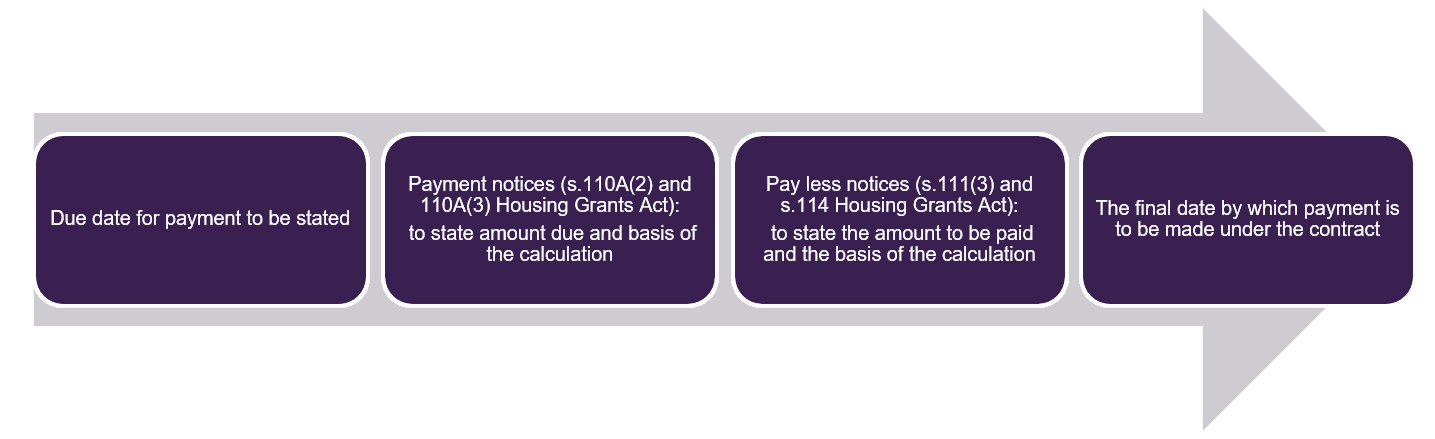
The diagram below summarises what makes an “adequate”
payment mechanism under the Housing Grants Act:14
Looking at standard forms: NEC and JCT
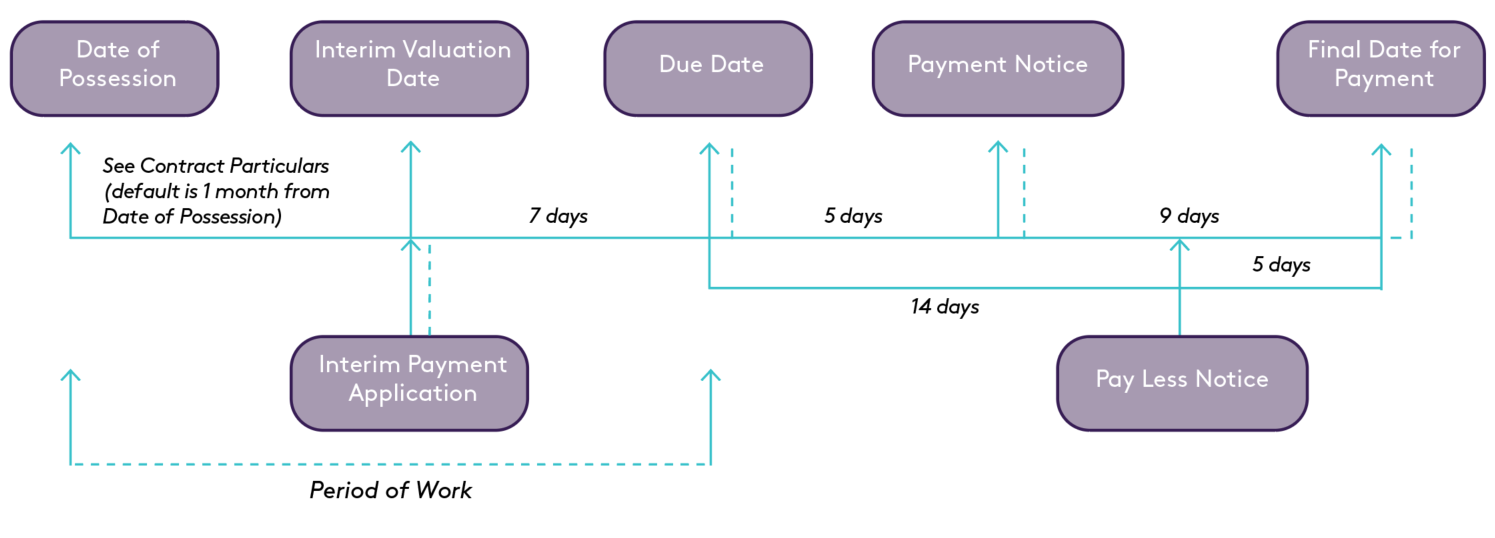
The standard form construction contracts (such as NEC and JCT) are compliant with the above requirements. The payment cycle for an unamended JCT Design and Build 2024 is set out below:
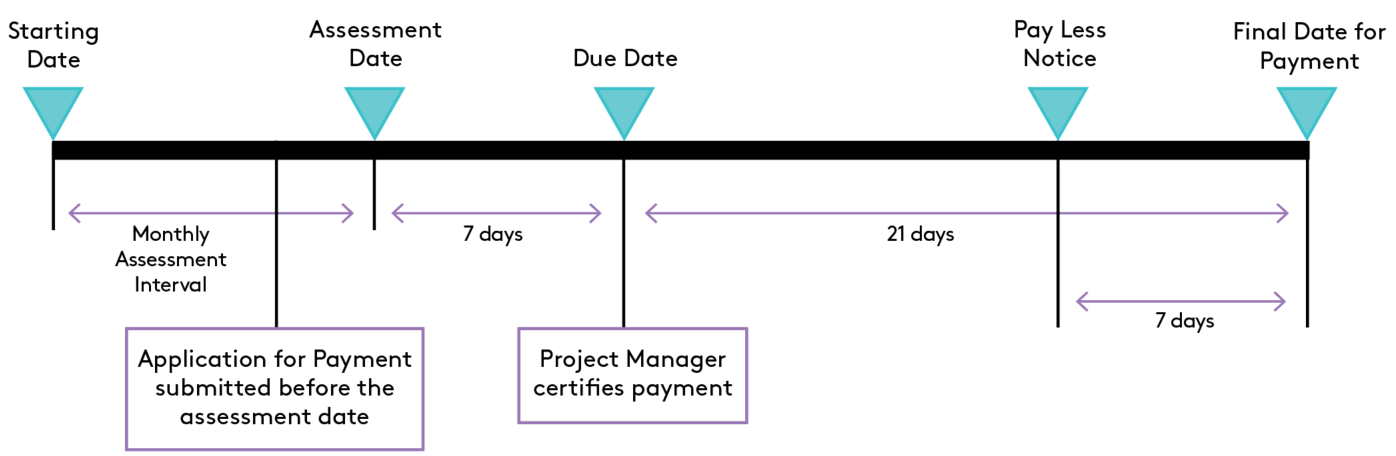
The payment cycle as set out in the unamended NEC4 Engineering and Construction Contract (ECC) is also set out below for convenience:
Common issues with payment notices and pay less notices
As smash and grab adjudications are based on a matter of technicality, it is important for both a payment notice and / or pay less notice to clearly comply with the Housing Grants Act. Simply labelling them “Payment Notice” or “Pay Less Notice” is helpful. All too often we see cases where the relevant notice failed to include the required information under the Housing Grants Act; for example, where the notice made no clear statement of the sum due or where the notice lacked the basis upon which that sum was calculated.15 Attaching the relevant document showing a detailed calculation is also helpful albeit not necessarily fatal if the notice itself contains a more basic calculation and cross refers to another identifiable document.16
Other arguments frequently revolve around whether a payment notice or pay less notice was ambiguous – be that because there are errors in the calculation, inconsistent terminology is used, or the notice fails to clearly indicate which application/payment cycle it relates to. Labelling and carefully proofing the document should avoid such issues.
What have the courts said?
Since the introduction of the adjudication regime in 1996, the courts have supported both adjudication and the principle of “pay now, argue later” in the context of payment notice disputes.17
Early decisions such as ISG Construction Ltd v Seevic College18 established that, where a payer fails to issue a valid payment or pay less notice, the sum applied for becomes immediately due, regardless of its true value. Grove Developments Ltd v S&T (UK) Ltd19 later clarified that a paying party is entitled to commence a true value adjudication after the first smash and grab decision to challenge the true value of the interim application. However, this principle has been extended to confirm that payment of the smash and grab decision must be paid before the true value adjudication can commence.20 It is no longer an option to race for a decision as to the true value before a smash and grab decision is rendered.
Subsequent cases, including Bexheat Ltd v Essex Services Group Ltd,21 reinforced the strict approach to compliance with notice requirements, and in Bresco Electrical Services Ltd v Michael J Lonsdale (Electrical) Ltd,22 the Supreme Court ruled that smash and grab adjudications remain available to a company with a payment notice dispute even if the company enters into liquidation.23
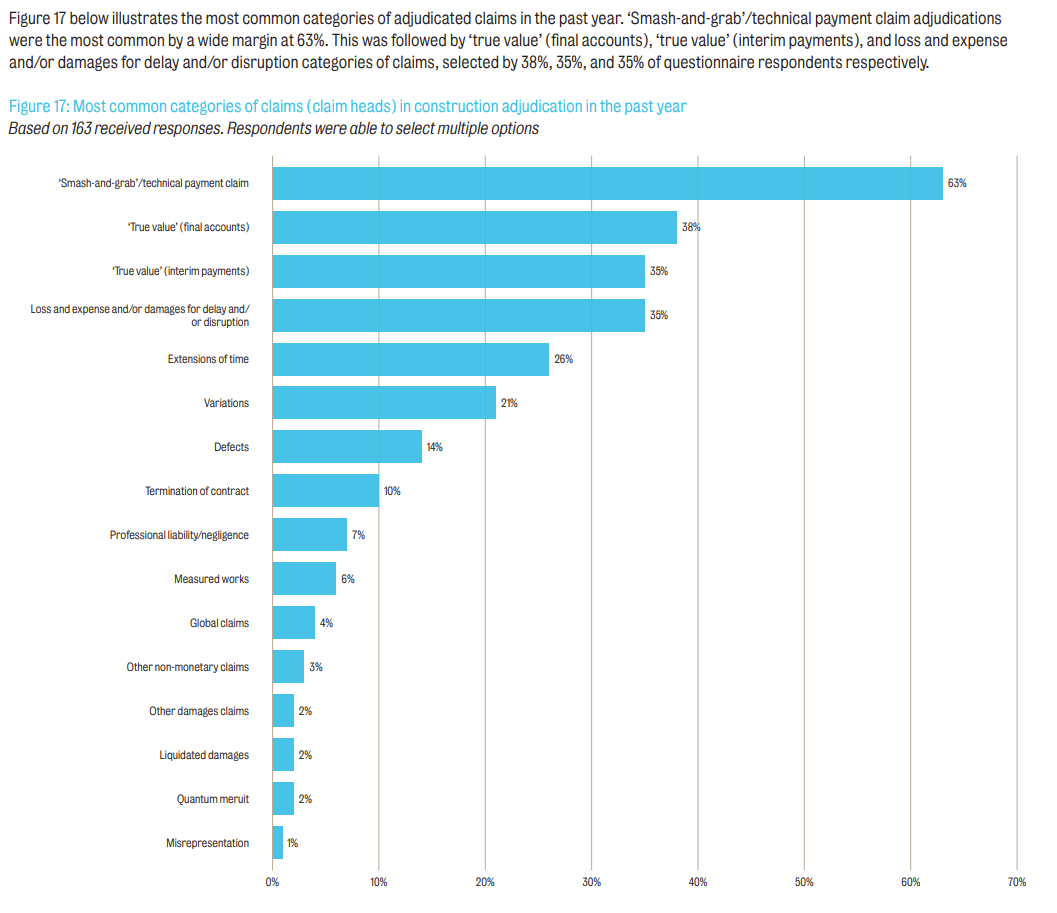
In that context it is perhaps not surprising that the King’s College’s 2024 Construction Adjudication in the United Kingdom showed that smash and grab adjudications were the most common type of adjudication commenced in the period studied.
Case law additions from 2025
During 2025 the Technology and Construction Court (“TCC”) reached numerous decisions on payment notice disputes and/or when smash and grabs will be allowed. So, what are the key principles flowing from that recent case law?
- Strict compliance is critical and cash flow remains the overriding objective
The TCC continues to adopt a firm approach to payment notices and pay less notices. The recent case of VMA Services Ltd v Project One London Ltd24 concerned a Sub-Contract Order which incorporated the JCT Design and Build Sub-Contract Agreement Conditions 2016. The decision handed down in VMA confirmed that, where a valid payment application is made and no compliant payment notice and / or pay less notice follows, the applied-for sum becomes a notified sum that must be paid immediately, regardless of any dispute concerning valuation.
- A true value adjudication cannot be used to sidestep payment obligations
Although a similar principle was initially set down by Grove, the recent case of VMA also confirmed that the paying party cannot rely on a true value adjudication to avoid paying a notified sum. The notified sum must be paid before pursuing a true value adjudication.
- Substance matters more than what a document is called
The courts are not impressed by a party seeking to rely upon contrived reasoning in order to void a notice. Placefirst Construction Ltd v CAR Construction (North East) Ltd25 recently confirmed that substance over form is important. A document can be a valid payment notice even if it is not labelled as one, so long as it states: (i) the sum considered due; and (ii) the basis of calculation.
RBH Building Contractors Ltd v James & Anor26 confirmed that the courts will not adopt an unnecessarily restrictive approach when looking at a notice. In that case, the pay less notice issued by Mr and Mrs James said that they “intend to withhold payment of £663,016.16 and accordingly intend to make a payment of £0” followed by a list of reasons for withholding the sums. RBH argued that this did not make clear what was being withheld or the reasoning behind the valuation of £0. The court was not convinced by this argument and confirmed it would not take an “overly prescriptive approach” to the contents of a notice as that would be contrary to the case law.
Placefirst also confirmed that payment notices and pay less notices can be served at the same time, but they must be kept as two distinct files. A single document cannot function as both notices, even if the notices contain the same content.
- Can a late payment notice operate as a pay less notice?
Vision Construct Limited v Gypcraft Drylining Contractors Ltd27 held that a document clearly intended to be and labelled as a payment notice cannot retrospectively be re-characterised as a pay less notice. In that dispute, Vision Construct Limited issued a payment notice on 7 February 2023 that was stated on its face and in the covering email to be a “Payment Notice”, but that notice was not issued in time. Vision Construct Limited did not serve a separate pay less notice but then sought to argue that the document issued on 7 February 2023 was, in fact, a pay less notice. The court did not agree with this argument and held that there was no doubt that the document was a payment notice (and therefore late). In other words, not only is labelling the document important but serving the notice in question on time is too.
Is genuine belief in the assessment necessary?
Following from Downs Road Development LLP v Laxmanbhai Construction (UK) Ltd,28 there appears to be a rise in arguments as to whether a party had a “genuine belief” in their assessment in a payment notice or pay less notice. In that case, the payment notice was first issued by Downs Road Development for £0.97, who then later issued a pay less notice for £657,218.50. As part of the enforcement proceedings, Laxmanbhai argued that the payment notice was not valid as it did not set out the sum that the employer genuinely considered to be due. Instead, the payment notice was a place-holding exercise.
The court did not accept the argument put forward by Laxmanbhai and noted that:
“It cannot realistically be contended that Payment Notice 34 accurately stated the sum which the Employer considered to be due at the payment due date. That is evident from the fact that the covering email said that a further notice would be issued. The Employer clearly envisaged that the further notice would set out a different figure which would be the figure which the Employer in fact considered to be due” [emphasis added].
The reasoning provided in Downs was very fact specific, but the idea that a party should have a genuine belief in their assessment is increasingly raised in arguments, so we may see this idea return before the courts in the near future.
The rise in Part 8 claims to try and prevent enforcement of an adjudication decision
Adjudication decisions are enforced through an expedited CPR Part 7 procedure which is set out at Section 9 of the TCC Guide. However, there are circumstances in which one party to an adjudication commences enforcement proceedings whilst the other commences proceedings under the Part 8 procedure to challenge the validity of the adjudicator’s award. In this instance, the court expects the parties to engage in sensible discussions so that the issues raised by each party can be raised in a single action.29
The TCC Guide also acknowledges that where an adjudicator has made a clear error, it can be possible to bring CPR Part 8 proceedings for a declaration to pre-emptively respond to the anticipated application to enforce the adjudication decision. In this instance, relying on the guidance of Coulson J (as he then was) in Hutton Construction Ltd v Wilson Properties (London) Ltd,30 the TCC Guide is clear that such cases are limited to those where:
- the issue is short and self-contained;31
- there is no oral evidence or any other elaboration;32 and
- the issue is one which it would be unconscionable for the court to ignore.33
The recent case law from the courts suggests that there is an upwards trend on the use of CPR Part 8 claims to avoid enforcement of an adjudicator’s decision.
However, the TCC and Court of Appeal have made clear on several occasions that where there are parallel Part 8 proceedings and Part 7 proceedings, the proper approach is for the Part 8 proceedings to be dealt with after the enforcement of the adjudicator’s decision (i.e. once the decision has been enforced).34
It remains to be seen whether there will be a continued rise in the use of Part 8 proceedings to prevent the enforcement of an adjudication decision in Part 7, particularly where the TCC’s approach to enforcement of even poor quality decisions is so strict, and whether there will be a rise in this as a strategy to defend against smash and grab adjudications.
What happens if you have a low-value dispute?
Although adjudication is a quick way of resolving disputes, the legal costs incurred in even the simplest smash and grab can add up, preventing them being pursued. To try to resolve this issue, the Construction Industry Council (“CIC”) has introduced the CIC Low Value Disputes Model Adjudication Procedure (“CIC LVD MAP”) (also supported by RICS). The adjudicator’s fee is proportionate to the value of the dispute thus providing the parties with certainty as to how much the adjudicator will be paid for making their decision.35
The CIC LVD MAP applies to disputes valued up to £100,000.00 and the adjudicator’s fees are capped in the following increments:36
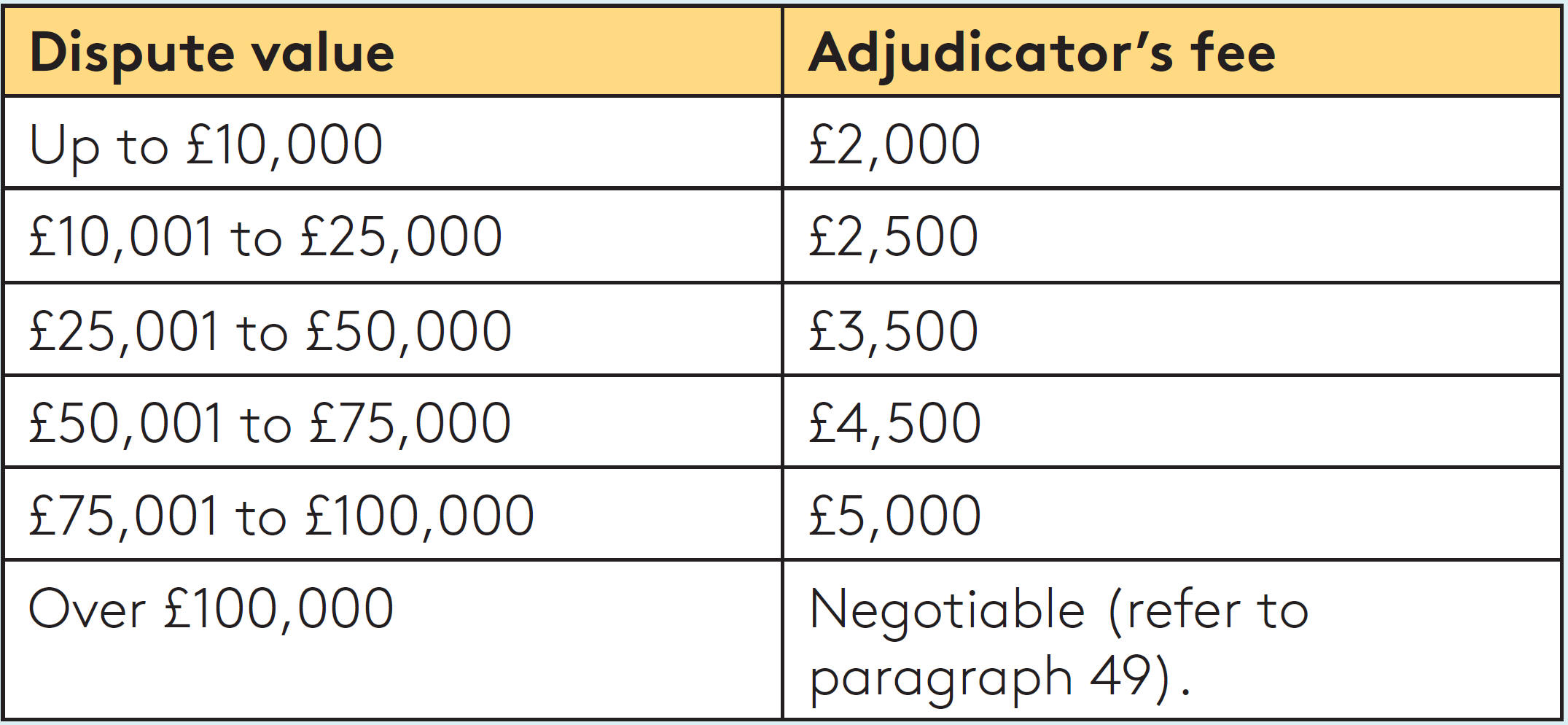
In the six months leading up to October 2025 RICS saw a 29% increase in the number of adjudications being referred under the CIC LVD MAP.
The ICE has also introduced a specific payment dispute procedure with capped fees via value which was detailed in a recent blog, “The ICE Payment Notice Dispute Model Adjudication Procedure: Worth considering?”, providing another option for low-value smash and grabs.
Practical tips for avoiding a smash and grab adjudication
So how should a smash and grab be avoided? For an employer or contractor seeking to avoid a smash and grab adjudication, following the golden rules below should stand you in good stead:
- Check the payment mechanism in the contract. As explained above, it is important to check that the contract payment mechanism complies with the Housing Grants Act. If it does not comply, the Scheme will “fill the gaps”, which could lead to a different payment regime than the one first envisaged in the contract. The standard forms provide compliant mechanisms so if in doubt stick with their rules.
- Diarise the key payment calendar dates. It is very important that those administering the contract are fully aware when applications for payment are to be issued and importantly when payment and pay less notices are to be issued. It is important to ensure that those dates are diarised, and caution must be taken when calculating the relevant dates – be careful as to how time is calculated under the contract (for example, as seen above in the standard JCT Design and Build Contract 2016 and NEC4). There is software available to help manage this process for large projects and particular care needs to be taken where there are multiple subcontracts to ensure that the dates work so that the process works efficiently.
- Be clear on the relevant content. There should be a detailed breakdown of your calculations within the notice that clearly explains what sum is due and how you have arrived at the gross valuation.37 Cross referring to other documents should be avoided unless there is no alternative. Including detail in the notice is far easier and less risky.
- Be clear on the relevant service requirements. The contract should provide who serves the notice in question, who the notices have to be served on and any relevant address (or email address) that must be used. A note should be made of this and any key individuals so that, should someone leave the project, the relevant information can be updated.
- Always issue a notice. It is essential that a notice is sent even if the recipient disputes the application. Any payment notice or pay less notice should clearly state the sum the payer considers due (including £0 if appropriate) and the basis of the calculation. Silence is not golden but can be deadly.
- Label the notice clearly. It is important to ensure that any notice is correctly labelled and states the contract clause under which it is being issued. For example, a pay less notice should clearly state that it is a pay less notice relating to Application Number x.38
For a subcontractor seeking to advance a smash and grab adjudication, a failure by the payer to follow the rules set out above provides such ability. However, as the payee, it is important that any payment for application should be free from ambiguity.39 Simply put, if a payment application does not meet the necessary requirements, then the smash and grab cannot commence.
Overview
Whilst the term “smash and grab” certainly has some negative connotations, the notice regime within the Housing Grants Act was designed to facilitate cash flow and allow parties to know what they would be paid and when. The regime as amended has been in place for a considerable number of years and yet basic mistakes continue and, if anything, the number of smash and grab adjudications appears to be increasing in the current economic climate. After all, cash flow is key. Following the rules above is accordingly ever more important. Do not be the one caught out!
- 1. See the King’s College Report on Adjudication 2024 at kcl-dpsl-construction-adjudication-report-3.0-2024-update-digital-aw1.pdf.
- 2. See Lord Justice Coulson in Bennett (Construction) Limited v CIMC MBS Limited [2019] EWCA Civ 1515 at paragraph 67.
- 3. [2013] EWHC 2722 (TCC).
- 4. [2016] EWHC 557 (TCC) at paragraph 39.
- 5. [2017] EWHC 1763 (TCC) at paragraph 17.
- 6. As defined by s.104 Housing Grants, Construction and Regeneration Act 1996.
- 7. S.109(1) Housing Grants, Construction and Regeneration Act 1996.
- 8. S.109(2) Housing Grants, Construction and Regeneration Act 1996.
- 9. A different scheme applies in Scotland.
- 10. S.109 Housing Grants, Construction and Regeneration Act 1996.
- 11. S.110 Housing Grants, Construction and Regeneration Act 1996.
- 12. S.110A and s.110B Housing Grants, Construction and Regeneration Act 1996.
- 13. S.111 of the Housing Grants, Construction and Regeneration Act 1996.
- 14. The extensive case law on this aspect alone is not covered further here.
- 15. S.110A(2), s.110A(3), s.111(3) and s.114 of the Housing Grants, Construction and Regeneration Act 1996.
- 16. See our guidance previously issued on pay less notice contents in Insight, Issue 87.
- 17. See, by way of example, M Davenport Builders Ltd v Greer, Broseley London Ltd v Prime Asset Management Ltd [2020] EWHC 944 (TCC).
- 18. [2014] EWHC 4007 (TCC).
- 19. [2018] EWHC 123 (TCC) and upheld subsequently by the Court of Appeal in S&T (UK) Ltd v Grove Developments Ltd [2018] EWCA Civ 2448.
- 20. M Davenport Builders Ltd v Greer and another [2019] EWHC 318 (TCC).
- 21. [2022] EWHC 936 (TCC).
- 22. [2020] UKSC 25.
- 23. As noted in Bresco, liquidators might not seek to summarily enforce the decision or alternatively might offer appropriate undertakings in terms of costs or to ring-fence any enforcement proceeds.
- 24. [2025] EWHC 1815 (TCC).
- 25. [2025] EWHC 100 (TCC).
- 26. [2025] EWHC 2005 (TCC).
- 27. [2025] EWHC 2707 (TCC).
- 28. [2021] EWHC 2441 (TCC).
- 29. See the TCC Guide, paragraph 9.4.4.
- 30. [2017] EWHC 517 (TCC).
- 31. The TCC Guide, paragraph 9.4.5(a).
- 32. The TCC Guide, paragraph 9.4.5(b).
- 33. The TCC Guide, paragraph 9.4.5(c).
- 34. See, for example, Structure Consulting Limited v Maroush Food Production Limited [2017] EWHC 962 (TCC), Hutton Construction Limited v Wilson Properties (London) Ltd [2017] EWHC 517 (TCC) and A & V Building Solutions v J & B Hopkins [2023] EWCA Civ 54.
- 35. Preamble to the CIC Low Value Disputes Model Adjudication Procedure (CIC-Low-Value-Disputes-Model-Adjudication-Procedure-Second-Edition_FINAL.pdf)
- 36. CIC Low Value Disputes Model Adjudication Procedure (CIC-Low-Value-Disputes-Model-Adjudication-Procedure-Second-Edition_FINAL.pdf) – Schedule 1.
- 37. Downs Road Development LLP v Laxmanbhai Construction (UK) Limited [2021] EWHC 2441 (TCC) at paragraph 48.
- 38. See Placefirst Construction Ltd v CAR Construction (North East) Ltd [2025] 100 (TCC).
- 39. See Henia Investments Inc v Beck Interiors Limited [2015] EWHC 2433 (TCC).
Key contacts
 Download PDF version (579.29 KB)
Subscribe to our newsletters
If you would like to receive a digital version of our newsletters please complete the subscription form.