



Why They Are Different, Why They Are Difficult and How They Are Proven
Introduction
Delay is a primary driver of cost overruns and disputes across all construction sectors. While standard conflicts over liquidated damages, extensions of time and prolongation costs remain central, data centre projects present a distinct risk profile. The specific technical, commercial and logistical demands of modern data centre delivery create unique scheduling pressures and contractual complexities that set the sector apart.
This paper will examine delay claims in data centre construction in two parts, as follows:
- Part 1 examines how and why data centre construction differs from traditional sectors, identifies common causes of delay and explores how these delays impact progress.
- Part 2 outlines the necessity for proactive management and provides a suggested framework for navigating the complexities of making a claim in this high-pressure environment.
Why data centre projects are different
Market pressure & hyper-growth
The current market is a primary driver of disputes. Capital expenditure by the world’s largest cloud providers is expected to reach record highs, possibly surpassing half a trillion dollars over the next few years. This AI-driven acceleration forces more ambitious footprints and complex MEP systems into compressed baseline schedules that rarely account adequately for design shifts or overstretched supply chains. Soaring growth has attracted new entrants with hard lessons to learn. ISG’s CEO, for example, cited loss making contracts in the data centre sector as one of the causes of its downfall.[1] These factors, compounded by the enormous commercial influence of “Big Tech” clients over the delivery chain, create fertile ground for parties failing to meet contractual obligations, giving rise to delays and disputes.
Scalability & phased completion
Scheduling risks vary by facility type. Enterprise data centres are built for internal corporate operations. Colocation data centres (“colos”) are divided into independent data halls, with complex overlapping phases. Hyperscale data centres are massive facilities designed for extreme scalability and efficiency.
Phased completion dates in colocation and hyperscale projects, coupled with other challenges of data centre construction explored in this article, create unique scheduling risks and require meticulous mapping of resource and physical constraints across multiple colos and phases.
Complex systems & coordination
At the most basic level, a data centre comprises data halls and supporting infrastructure, including a cooling system, electrical network and equipment, control rooms and an administrative block.
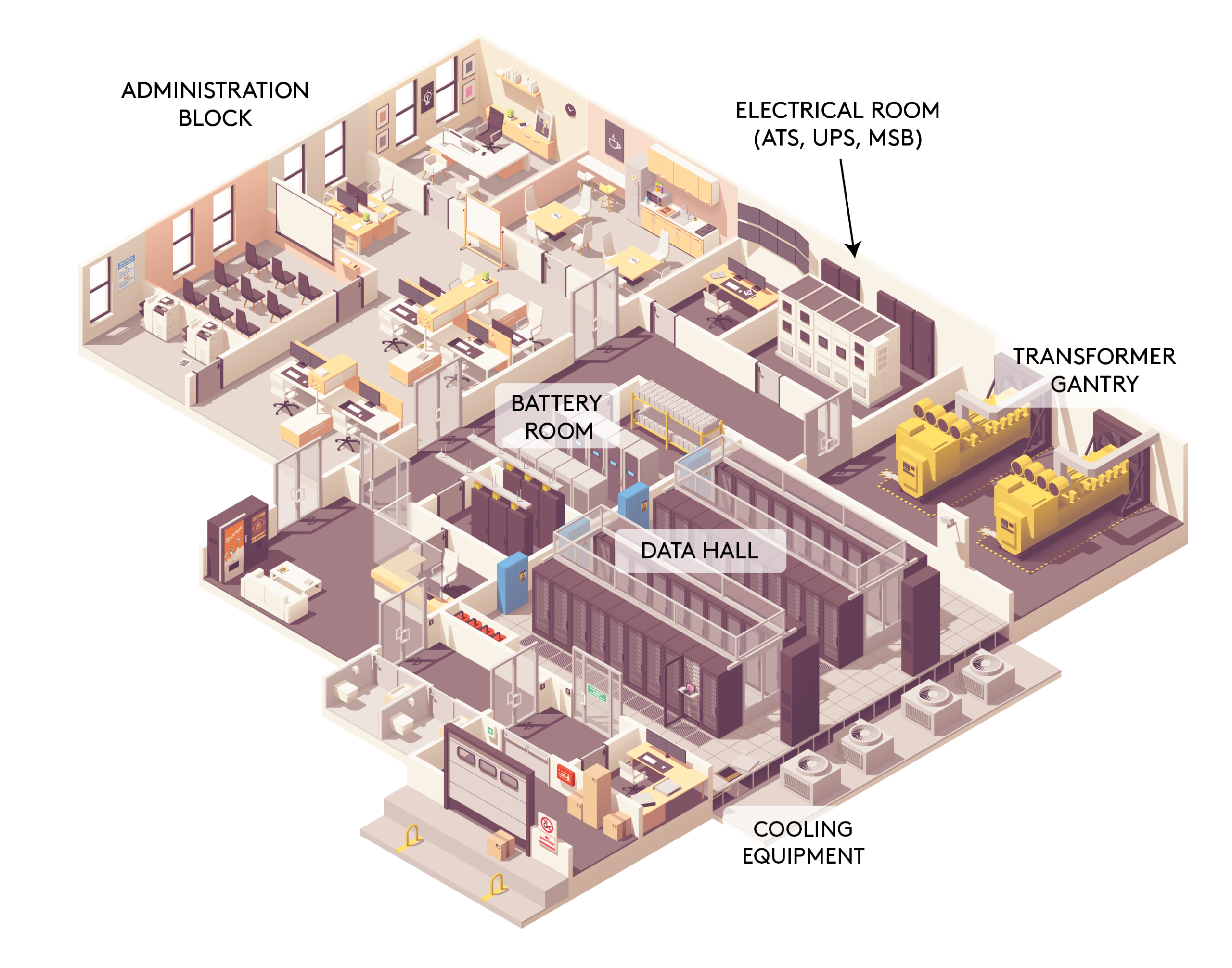
However, the building is essentially subordinate to its systems, which comprise hundreds/thousands of advanced equipment and panels. A modern data centre is a highly engineered environment maintaining precise power quality, temperature, humidity, dust concentration and air pressure, while ensuring uninterrupted service (and therefore requiring uninterrupted power). Consequently, the construction sequence, from civil works to specialist work (like BAS, EPMS and SCADA), is governed by the density and interconnectivity of the various trades involved. Each discipline relies on the timely completion of preceding tasks. Successful delivery therefore hinges on careful planning, continuous collaboration and clear communication across various trades.
Furthermore, the sheer volume of assets and parties involved makes pre-energisation inspections and later commissioning inordinately long and particularly challenging processes.
Common causes of delay
Trade-to-trade delays
Trade-to-trade handover delays have significant knock-on impacts due to the high trade density in each space. A common cause is late transition from civil works to internal fit out, delaying the installation of wall panels, ceilings and primary containment. Following this initial handover, activity coordination remains a primary scheduling risk due to the high volume of specialist contractors and vendors (fit out, electrical, mechanical and communication infrastructure) working in the same space.
Environmental constraints & weathertightness
Data centre construction involves stricter quality requirements and constraints than typical construction projects. For example, the systems (servers, storage, network switches) have specific installation requirements and environmental conditions are paramount. The presence of too much moisture or dust in the atmosphere will prevent the installation of sensitive – and often critical – electrical equipment and/or systems. Consequently, issues which on other projects could be worked around or might be considered snagging can prevent vital works proceeding and have a far-reaching impact on progress.
Supply chain delays
Critical paths are frequently driven by long-lead specialist items, including switchgear, UPS systems, chillers and CRAC units. A key commercial risk is manufacturer over-commitment. When capacity is exceeded, delivery priority often shifts to clients with the greatest commercial leverage over vendors. This risk is compounded when equipment is owner-furnished, leaving contractors with no direct contractual recourse against vendors. Due to their global nature, supply chains are vulnerable to being further stressed by geopolitical issues such as tariffs and wars.
Design delays
The speed of evolution of the technology housed within data centres is faster than the construction and commissioning of a large data centre. This rapid evolution, coupled with a desire for value engineering, can prevent a timely design freeze, leading to rework and procurement delays. Examples of such design changes include revision of the cooling specifications, or an increase in the power load due to added equipment.
Skilled resource shortage
The “gold rush” for AI capacity often outpaces the available pool of qualified personnel. Contractors and subcontractors face competition for specialised, experienced manpower which can impact progress with specialised activities regardless of available work fronts and equipment delivery.
Commissioning delays
Late availability of permanent power, cooling water, or network connectivity is a common bottleneck that affects the progress of commissioning. Delays frequently also arise due to the sheer number of parties involved in the process whose participation must be coordinated: vendors, commissioning agents, specialist subcontractors, main contractor, owner. A resource limitation for a single party can affect the progress of the entire testing sequence. Successful commissioning requires careful management of resource constraints as well as potential physical constraints such as shared busbars, load bank availability and power capacity.
A frequent, yet avoidable, cause of delay in data centre projects is the absence of a detailed, logic-linked commissioning plan. Without this roadmap, the transition from construction to operations can descend into a series of reactive, uncoordinated hurdles.
The following section examines how those issues, and other causes of delays, reflect on the schedule.
How the delays may impact progress
Identifying the extent and causes of delay (or recovery) to the critical path activities is no simple task, particularly when delay claims are not made until nearer project completion. By way of example, the impact of trade-to-trade and equipment delays on progress varies. In each case analysis is required of the impact of the delay event on the critical path to establish whether critical delay occurred. Additionally, in a forensic delay analysis, it is common to identify the effect of the delay first prior to the cause of the delay.
Common scenarios that arise include:
- Delay to start: delay in one activity often forces a day-for-day slip in starting the subsequent activities, i.e. a domino effect. For example, late completion of the civil and structural works may prevent the start of installation of the fire detection system, as well as all the subsequent electrical and fit out activities.
- Extended duration / delay to progress: when delayed activities begin to overlap, they create physical clashes. For example, equipment delivery may be scheduled to take place after primary containment installation to reduce access constraints. If containment installation coincides with equipment delivery delays can occur to completing both containment and equipment installation due to the interface and access constraints imposed by each upon the other.
- Stacking of resources: delays to earlier works can result in multiple areas becoming available to a subcontractor at a similar time, such that it may be required to work across those multiple areas simultaneously. Specialist trades, such as Building Automation Systems (“BAS”), are particularly vulnerable to this issue. If the subcontractor cannot increase their specialised workforce or focus on critical path areas, the over-stacking of their resources can affect the project completion.
Interconnectivities and dependencies between systems mean that delay by a single vendor/specialist contractor may delay completion of other multiple systems, either directly or indirectly. This is particularly the case with progress through the various stages of terminations, testing and commissioning.
Furthermore, delay in one section/phase/colo can be felt in others. This is because some over-arching considerations govern the sequence of works across different areas or parts of the overall project. Cabling terminating at multiple areas may share the same containment, and thus all the cable pulling in that containment may need to be substantially completed prior to energisation in any of those areas. Testing of certain equipment in one area can also halt testing of equipment in another area if testing relies on a shared busbar. Commissioning resource constraints – including availability of vendor agents, power capacity and load banks – may necessitate a minimum stagger between completion of phases/colos.
Identifying such dependencies in planning meetings and maintaining clear, reliable records of delay caused by them is recommended.
Part 2 of this article will discuss what to do when the delays occur, how to manage delays on the project and how to make a claim in respect of critical delay caused.
[1] ISG boss apologises to staff in late night email | Construction Enquirer News
