



The Housing Grants, Construction & Regeneration Act (“HGCRA”) came into force in May 1998.[1] Ten years have now passed, so has adjudication been a success? Sir Michael Latham wanted adjudication to become the “key to settling disputes in the Construction Industry”.[2] There is no doubt that adjudication has become a popular and accepted form of dispute resolution encouraged by the courts and adopted by many as a way of resolving disputes both interim and final. Indeed, adjudication is now used to deal with many complex disputes which may well have been outside the ambit of those who originally drafted the legislation.
Adjudication owes much of its success to the attitude of the courts, who have shown their willingness to enforce the decisions of adjudicators. Today, there is a pro-adjudication approach amongst the judiciary, which was clearly demonstrated by Mr Justice Jackson in his judgment in the Carillion v Devonport[3] case:
“76. Prior to 1998, if there was a dispute about payment within the construction sector, money would generally remain in the pocket of the paying party until final resolution of that dispute. This was a source of concern …The statutory system of compulsory adjudication was set up to address this problem. The purpose of an adjudication was and is to determine who shall hold the disputed funds, and in what proportions, until such time as the dispute is finally resolved…
78. adjudication has been widely used in the construction industry. On many occasions, the parties have chosen to use the adjudicator’s decision as, or as the basis for the final settlement of their disputes. This is a perfectly sensible and commercial approach.
80.2 The Court of Appeal has repeatedly emphasised that adjudicators’ decisions must be enforced, even if they result from errors of procedure, fact or law…”
There have been many statistics produced over the years, and the construction industry is particularly grateful for the work carried out by the Adjudication Reporting Centre Report at Glasgow Caledonian University. As can be seen from the Table below[4] there have been at least 15,000 adjudications since 1 May 1998, a figure which in itself suggests that adjudication has been a success.
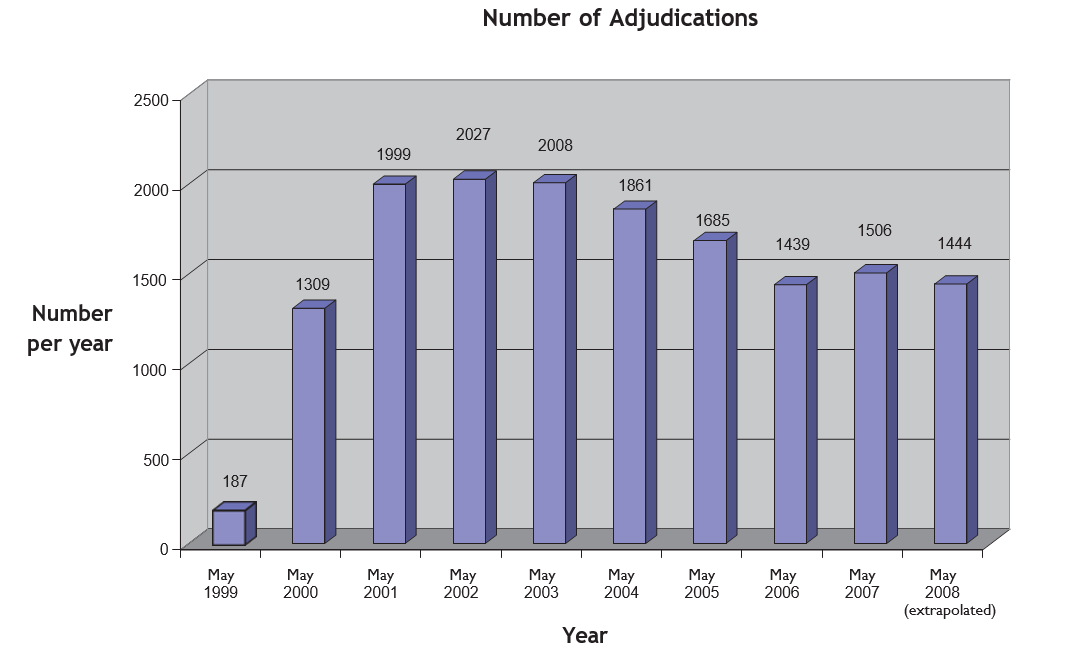
Adjudication has undoubtedly speeded up the dispute resolution process in the construction industry generally. Many adjudication panels have been set up, including a panel for the 2012 London Olympics. Further adjudication is now starting to establish itself, not merely as a British procedure, but as a feature of other common law jurisdictions as well. So, there is no doubt that adjudication is here to stay, something confirmed by the proposed reforms to the Housing Grants Act, which are clearly intended to widen the availability of adjudication, throughout the construction industry.
[1] Of course, the origins of the process are far from new: Dr Stephen Inwood has noted that Robert Hooke (1635-1703), who in collaboration with Sir Christopher Wren did much work in the reconstruction of London after the Great Fire, “carried out occasional views on properties in the City, providing professional adjudications in disputes between property owners or builders, usually for a fee of 10s” (The Man Who Knew Too Much; Pan, 2002, page 386). See Chapter 5 of Building Contract Disputes: Practice and Precedents.
[2] Constructing the Team.
[3] 2005 EWHC 778 (TCC).
[4] Adjudication Reporting Centre Report No. 8 – November 2007.